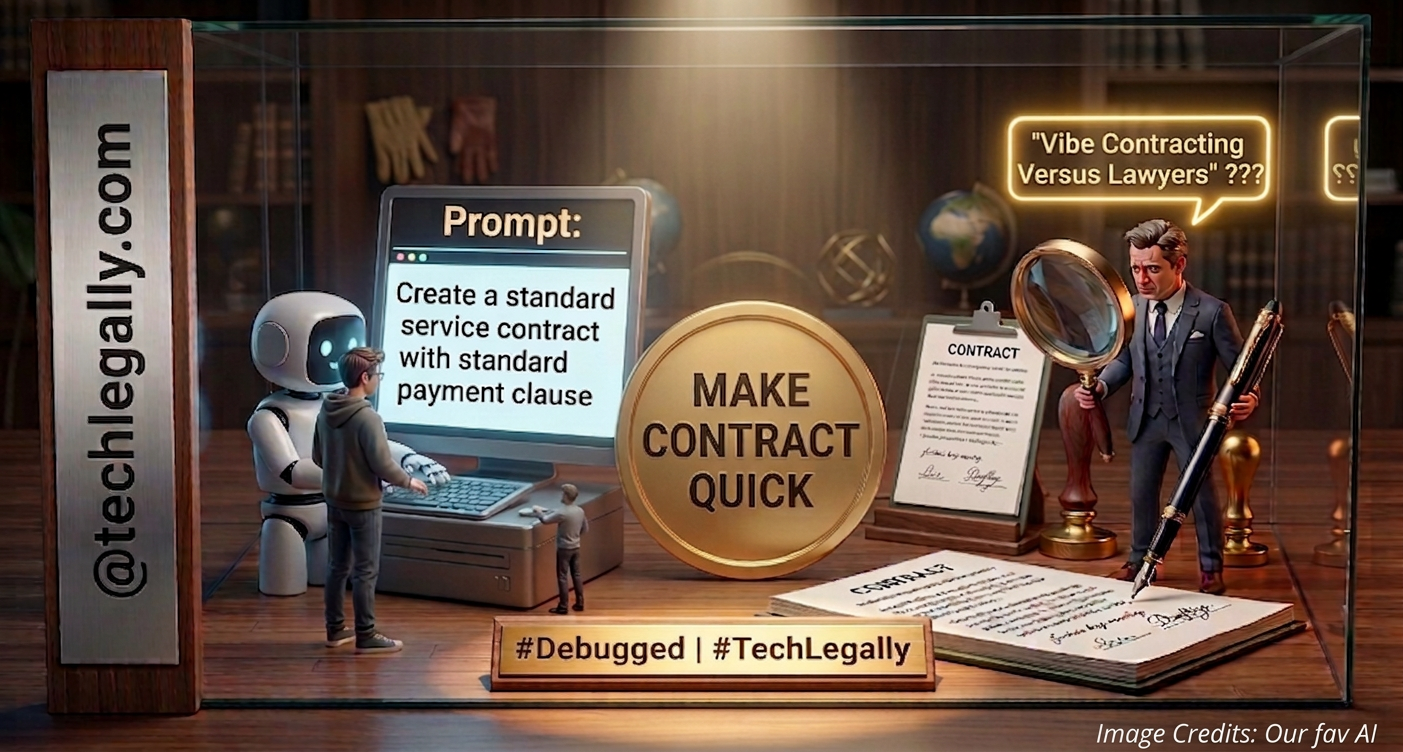
I’m sure, by now you’ve heard about ‘Vibe Coding’.
Yes, it’s the all-encompassing term in this AI infused world. You’re likely familiar with how Andrej Karpathy popularized this term. And his message was clear: ‘the hottest new programming language is English’. Oh boy! It sure is!
We’ve seen many of our developer friends open their laptops, write prompts to a GPT in plain simple English. The GPT generates the code, and they copy-paste it on the programming block – sometimes with a few (hopefully) significant tweaks. Yes, these coders are effectively ‘Vibe Coding’.
Something similar is also happening to our Contracts and the world of contracting! If you’re a contract lawyer, you know exactly what I mean.
These days, we lawyers silently pray when business/clients ping us with ‘please review attached contract’ requests. Our first thought? ‘God, not another AI generated draft!’. Because at that point, we’re not just reviewing – we’re essentially redrafting, sometimes from scratch.
Now, don’t get us wrong. We aren’t AI haters. In fact, we’re fascinated by the potential that AI holds. But everything hinges on the quality of that prompt. When business teams provide basic prompts, the AI returns a basic draft – one where most critical rights may not be covered.
Let us show you a clause generated by AI:
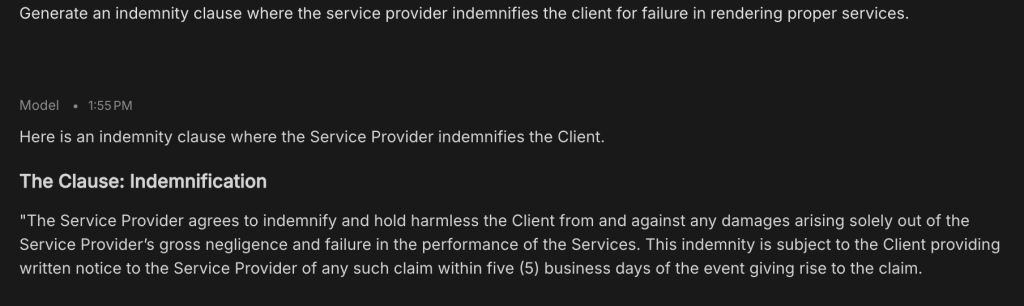
Sounds nice, short and simple, right? But is it legally foolproof? Does it protect your (here, ‘Client’s’) rights completely? The answer is a hard NO.
Now, here are some of the major loopholes in the GPT generated clause, that any lawyer’s eye would easily catch:
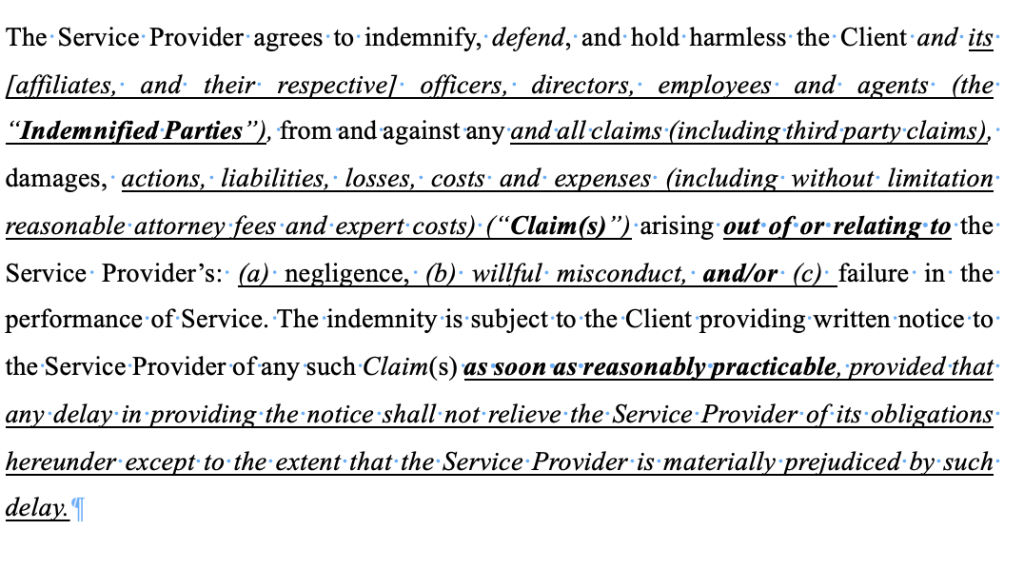
- The ‘solely’ trap: By using the word ‘solely’, the Service Provider could argue they don’t have to indemnify the Client if the Client is even slightly at fault.
- ‘Third Party Claims’: Indemnity is mostly used when a third party (like a customer) sues the Client because of the Service Provider’s mistake. This clause should’ve mentioned that categorically.
- Gross Negligence: This increases the burden of proof on the Client, since the Service Provider will now have to indemnify only on ‘gross’ negligence and not simple mistakes or standard errors.
- Notice Period: A rigid 5 day notice period creates unnecessary legal risk and should be avoided.
So, how will a lawyer modify this clause (please note, we aren’t including other intricacies here):
Here’s a sly little secret about AI in Contracting: it can actually help us – lawyers!
When lawyers use AI in contracting, it can be a gamechanger. It’s not replacing us (yet!); but it acts as our hyper-efficient paralegal. Lawyers can use these tools to:
- summarize a 77-page Master Service Agreement in seconds,
- quickly extract key dates,
- flag deviations from our standard playbooks
- increase efficiency in review, commenting, and
- Much more!
If lawyers can insert efficient, well-informed prompts plus know when and how to tweak them, AI can be used to assist with lawyering.
So, to all the tech-savvy founders, enthusiastic sales leaders, and brilliant business minds out there: We love your energy. We love that you are embracing the future. But please – trust us with our job.
How can you help us lawyers in the day and age of AI Contracts, you ask? Just do as you did before:
- Send us your bullet points;
- Tell us your commercial goals;
- Tell us what risks you envisage regarding this deal ;and
- Try to give us more time than EOD (please!)
Our take for lawyer compatriots: AI is absolutely going to expand our horizons. It may also eventually change how the legal contracting industry operates. But will “Vibe Contracting” replace actual lawyers? Not yet (or so we think). Not as long as business involves nuances, complex negotiations, and the need to anticipate the risks inherent in any partnership. Sure, it may (and probably will) make teams leaner, but if you have the right skill set (and many of those relevant ones) your job is safe. But now we sure can do more in lesser time – yet the ‘EOD today’ timeline will always remain tough to meet.
What do you think?
Let us know your opinion at [email protected]
